

Literature
I’d choose Milton for epic moral conflict and Pope for wit and social satire. For your library, I’d check the text before the binding: Paradise Lost appeared in 10 books in 1667 and 12 in 1674, while Pope’s satires changed through revision.
My comparison covers their place in literary history, verse, classical models, themes, influence, and editions. <u>They share classical roots - not the same approach.</u>
Quick Comparison
What I compare | Milton | Pope |
|---|---|---|
Historical place | Seventeenth-century precursor to neoclassicism | Central eighteenth-century Augustan poet |
Verse and style | Unrhymed blank verse; long sentences and lofty language | Rhymed heroic couplets; balance and sharp wit |
Classical models | Epic scale drawn from Homer and Virgil | Translation, imitation, and mock-epic satire |
Main themes | Free will, obedience, and faith | Reason, vanity, and social judgment |
Later influence | Epic ambition and Romantic poetry | Satire and literary taste |
Edition checks | Paradise Lost: 10- or 12-book text | The Rape of the Lock and The Dunciad: version and revisions |
For either poet, I’d also check notes, missing pages or plates, binding condition, rarity, and documented ownership. A reading copy and a collectible printing need different checks.
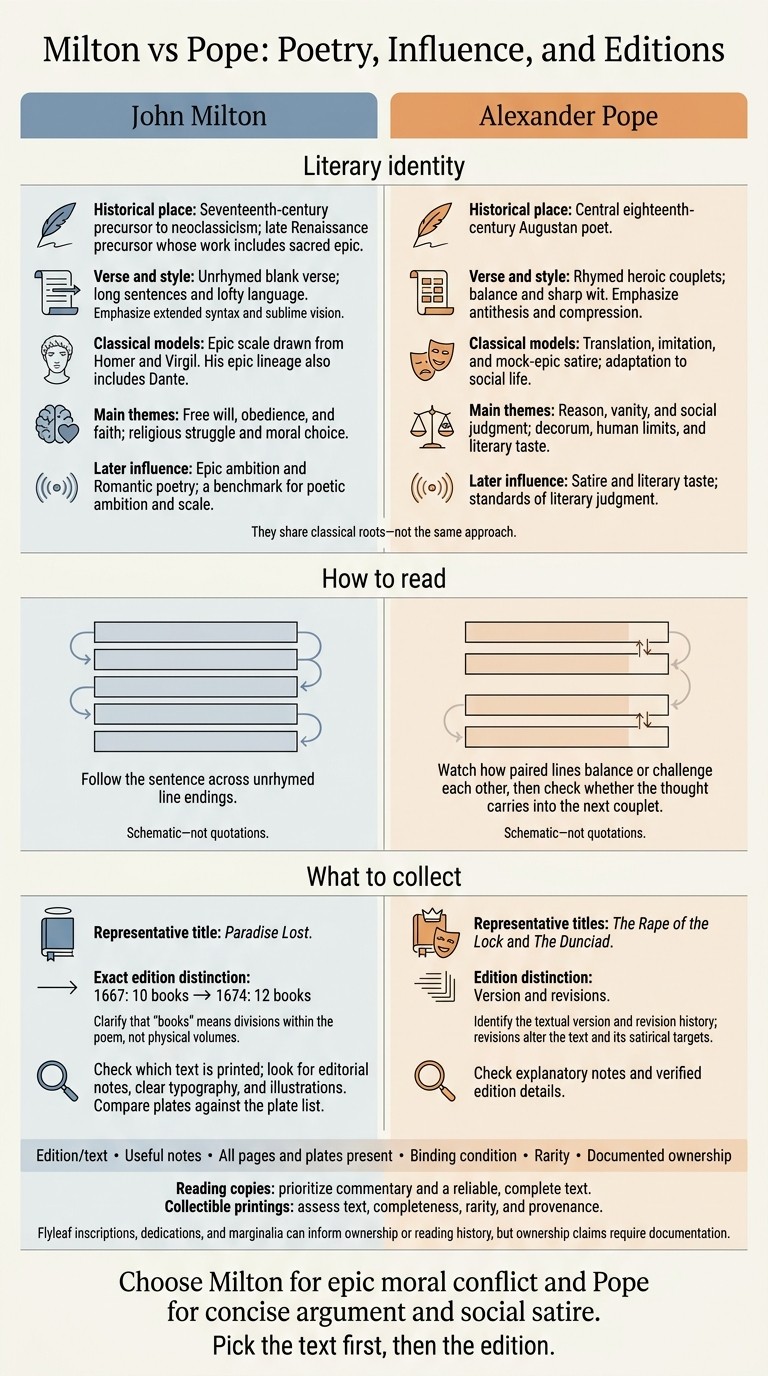
Milton vs Pope: Poetry, Influence, and Editions
English Poetry Lecture 12 English Poetry Neoclassical Augustan Poetry
Milton vs Pope: Form, Style, and Themes
Criterion | Milton | Pope |
|---|---|---|
Historical position | Late Renaissance precursor to neoclassicism; sacred epic | 18th-century translator and adapter of classical works |
Verse form | Blank verse with extended syntax | Heroic couplets with balance and compression |
Classical method | Measured his ambition against Homeric models | Translation, imitation, and adaptation to social life |
Style | Sublime vision and lofty diction | Controlled wit and sharp contrasts |
Core concern / tension | Free will, obedience, and religious struggle | Reason, decorum, and social judgment |
These are tendencies, not fixed boundaries. Both poets use classical models to examine moral questions, but their verse creates different reading experiences. Sentence movement, line breaks, and argument make those differences clear.
Milton: Sacred Epic and Moral Choice
Milton belongs to the epic lineage that runs from Homer through Virgil and Dante. His sacred epic sets religious struggle within a classical framework. Blank verse and extended syntax carry his ideas across line endings, while free will and obedience drive the moral conflict. The poem’s scale gives that conflict its urgency.
Pope: Heroic Couplets and Social Satire
Pope works with classical models through translation and adaptation, especially in his 1725 translation of Homer's Odyssey. His heroic couplets rely on balance, antithesis, and compression. His mock-epic wit examines vanity, human limits, and literary taste, turning observations about society into judgments. In his translation, he stresses intellectual control and range.
Reading Milton and Pope: Epic Scale vs Concise Argument
With Milton, follow the sentence across unrhymed line endings. Pausing at every line can hide the argument. With Pope, watch how paired lines balance or challenge each other, then check whether the thought carries into the next couplet.
These differences shaped each poet’s later reputation and the kinds of editions readers and collectors prize.
Milton vs Pope: Literary Influence
These formal differences also shaped how later readers judged each poet. Both poets’ influence affects how their work is read and what collectors seek. Notes, introductions, and reliable texts help readers understand that legacy.
Area of Influence | Milton | Pope |
|---|---|---|
Influence on later poets | Sets a benchmark for poetic ambition and scale. | Shapes later standards of literary judgment. |
Lasting value | Helps readers trace the English epic tradition as it develops over time. | Shows how poetic form guides interpretation. |
Milton’s Influence on Romantic Poetry
Milton’s visionary ambition offers a useful starting point for reading Romantic poetry. Later poets tried to match the scale of his work, drawing on his ambition and poetic vision.
Pope’s Legacy in Satire and Literary Taste
Pope’s legacy rests partly on his satire and his interpretation of classical literature. His translations show how order shapes judgment and Augustan craft, making them worth reading for those who care about carefully formed literary judgments.
Collecting Milton and Pope: What to Check
Edition differences matter to collectors because they change the text a reader owns. Before buying, check edition, rarity, condition, and provenance. Appearance alone doesn’t determine value.
Author | Representative Title | Edition context | Edition Features | Condition and Completeness | Provenance | Collector value |
|---|---|---|---|---|---|---|
John Milton | Paradise Lost | Original or revised arrangement | 10-book vs. 12-book arrangement; editorial notes; typography; illustrations | Sound binding; all text and plates present | Documented ownership; flyleaf inscriptions | Key Milton text for studying editions |
Alexander Pope | The Rape of the Lock | Original or expanded satire | Identified textual version; revision history; explanatory notes | All text and plates present; verified edition details; sound binding | Ownership records, dedications, and marginalia | Best for tracking revision history |
Milton Editions: Text, Illustrations, and Condition
Start by checking which text the Milton edition prints. The original ten-book Paradise Lost differs from the revised twelve-book arrangement, and that division shapes how readers move through the epic’s broad structure. Check the text itself, rather than relying on the cover description. For reading copies, look for clear type, useful notes, and an intact structure.
Compare the plates against the plate list, then check for missing pages, missing plates, and binding damage. Record flyleaf inscriptions, but verify any ownership claims with documentation.
Pope Editions: Revisions and Printing History
For Pope, revision history matters just as much as condition. Identify the version of The Rape of the Lock or The Dunciad: revisions alter both the text and its satirical targets. Check the notes, confirm that all text and plates are present, and verify the edition details. Then inspect the binding and evidence of ownership.
Reading copies and collectible printings serve different purposes. Choose reading copies for commentary; assess collectible printings by their text, completeness, rarity, and provenance. Handwritten notes can reveal a reader’s response and add to the book’s intellectual history.
Conclusion: Choosing Milton and Pope for Your Library
After comparing form and influence, your choice comes down to what you want to read and the quality of the edition. Pope defines Augustan neoclassicism with balance, wit, and social criticism. Milton sits just outside that school - a precursor whose sacred epic and sublime vision shaped later poetry.
Choose Milton for epic moral conflict and Pope for concise argument and social satire.
If you collect books as well as read them, the edition matters as much as the author. Pick the text first, then look for an edition with a strong introduction, useful notes, and material that puts the work in context.
Timeless Book Club highlights carefully selected classics in lasting collectible editions.
FAQs
Why read Milton alongside neoclassical poets?
Reading Milton alongside neoclassical poets helps readers see how the literary canon took shape. Later poets used Milton’s work as a benchmark for their own ambitions and craft. Reading them together shows how epic form changed and how later writers responded to earlier structures and themes.
Timeless Book Club supports this approach with curated editions that draw connections between works and help readers better understand the lasting literary tradition.
Which poet is easier for a first-time reader?
Alexander Pope is generally easier to read than John Milton. Pope’s clear, precise neoclassical style and heroic couplets give his poetry structure and rhythm. Milton’s epics, by contrast, combine complex syntax, dense classical allusions, and blank verse - a tougher starting point for readers new to the genre.
Timeless Book Club offers curated, high-quality editions of these classics, with scholarly support to help readers engage with either poet.
How can I verify an older edition’s authenticity?
Check the book’s physical condition and provenance (ownership history). Notes in the margins, including academic annotations, can offer clues about its past and previous owners. When buying, choose independent marketplaces where sellers describe the book’s condition, special features, and inscriptions in detail.
For a rare or fragile first edition, keep notes in a separate reading journal rather than writing on the pages. This helps preserve the book’s integrity.


