

Literature
If I were building a home library from these 6 classics, I’d start with The Odyssey. It gives me the oldest work in the set, a strong sense of where later fiction begins, and a clear reason to care about edition choice.
Here’s the short version:
I’m comparing 6 books: Pride and Prejudice, Jane Eyre, Moby-Dick, War and Peace, Great Expectations, and The Odyssey.
I’m judging them by 4 points: literary weight, reread value, range of themes, and edition appeal.
If I want an easier start, I’d look first at Pride and Prejudice, Jane Eyre, or Great Expectations.
If I want a long reading project, I’d pick Moby-Dick or War and Peace.
If translation matters most to me, The Odyssey stands out right away.
For collectors, notes, glossaries, afterwords, and bilingual text can matter as much as the cover.
A few fast takeaways:
Best first pick:The Odyssey
Best easy entry point:Pride and Prejudice
Best Gothic novel here:Jane Eyre
Best for slow rereading:Moby-Dick
Biggest time commitment:War and Peace
Best Dickens starting point:Great Expectations
Why this matters: edition choice can change the whole reading experience. In this list, 2 books stand out most for edition support: The Odyssey because of translation, and War and Peace because translation and notes shape how the book reads.
Classic Book Editions: Ultimate Guide to 19 Collections
Quick Comparison
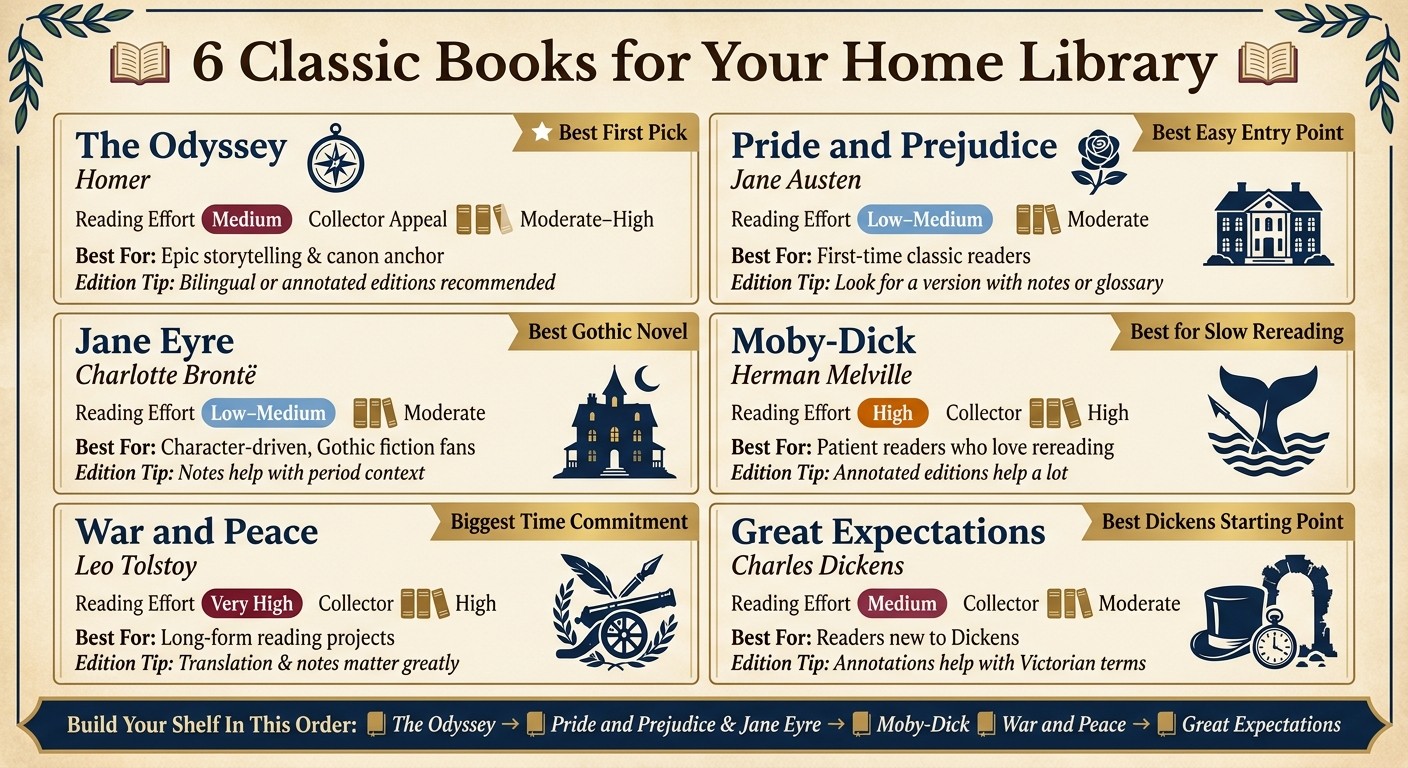
6 Classic Books for Your Home Library: At-a-Glance Comparison
Book | Best Known For | Reading Effort | Best For | Edition Tip |
|---|---|---|---|---|
Pride and Prejudice | Social wit and irony | Low to medium | First-time classic readers | Pick a version with notes or a glossary |
Jane Eyre | Inner conflict and Gothic mood | Low to medium | Readers who want strong character focus | Notes can help with period context |
Moby-Dick | Symbolism and reread depth | High | Patient readers | Annotated editions help a lot |
War and Peace | Scale, history, and family life | Very high | Long-form reading projects | Translation and notes matter a lot |
Great Expectations | Class, money, and personal growth | Medium | Readers new to Dickens | Annotations help with Victorian terms |
The Odyssey | Epic journey and homecoming | Medium | Readers who want an early canon anchor | Bilingual or annotated editions are a smart pick |
In short, I’d build the shelf in this order: The Odyssey, then Pride and Prejudice and Jane Eyre, then Moby-Dick and War and Peace, and finally Great Expectations to round it out.
1. Timeless Book Club collectible classic editions
Timeless Book Club treats classic literature as the kind of reading people come back to again and again. So for them, a great edition isn't just about looking good on a shelf. It needs to support rereading, close study, and deeper engagement over time.
That idea shows up clearly in how these books are made. The editions pair the English text with the original language and put translation decisions front and center, with notes and translation choices that give readers more to notice on each pass. The Odyssey is the clearest example.
The Timeless edition places the English text beside the original Greek, so readers can compare meaning line by line. That level of editorial care turns a classic into more than a one-time read. It becomes a book you can revisit, study, and see in a new way each time.
These editions bring together literary weight and collector appeal. They're made to be read, discussed, and returned to, not just displayed. With that standard set, the next titles show why these classics still matter so much.
2. Pride and Prejudice
As a core home-library classic, Pride and Prejudice sets the bar for the novel of manners, a form shaped by psychological sharpness, irony, and close attention to social life. Its take on class, reputation, and social pressure still lands today.
Austen’s layered irony is a big part of why the book holds up so well on a reread. Each return tends to show you a bit more about sincerity, social performance, class, and gender roles.
The main conflict isn’t just about marriage. It’s about the way class, custom, and unspoken social rules press on personal happiness. That tension gives the novel its bite.
Editions with a reading group guide, a glossary of Regency slang, or historical afterwords are worth a look because Austen’s social world is packed with period-specific meaning, and that added material can deepen both study and discussion. Collector-style hardcovers bring shelf appeal and study use, while paperbacks keep the book easy to pick up and read.
From social comedy, the list moves to a darker study of identity and independence.
3. Jane Eyre
Charlotte Brontë's Jane Eyre (1847) is still a Gothic classic with lasting influence, strong emotional pull, and solid shelf value. Its draw comes from its emotional depth, rich sense of history, and controlled prose.
Where Pride and Prejudice moves through social comedy and irony, Jane Eyre looks inward. Jane's voice is direct and morally clear, and her story digs into class, gender roles, and the pull between selfhood and duty. That's a big reason the novel holds up so well on a second or third read.
The book's historical mood gives it Gothic force and makes close reading worth the effort. As a home-library staple, it brings together theme, character, and collectibility in equal measure.
That mix of inner conflict and Gothic strain opens the door to the next novel's much larger scale. The list now shifts from private moral struggle to a story with a far broader reach.
4. Moby-Dick
Moby-Dick belongs in a home library for a simple reason: it gives more back each time you return to it. The book is ambitious, packed with symbolism, and built in layers. Its shifting voices, technical passages, and deep meaning make it the kind of novel that changes a bit on each reread. In that sense, it sets up War and Peace well, since that novel takes the same big reach and pushes it into history.
For collectors, annotated editions are often the smart pick. They make the novel much easier to move through. Glossaries, maps, and explanatory notes matter more than decorative touches here. Those extras help readers sort through the whaling terms, nautical detail, and dense references without getting lost. That mix of scale and difficulty also makes Moby-Dick a strong bridge from more intimate novels to the larger canvases that come next.
5. War and Peace
If Moby-Dick asks for patience, War and Peace pays you back with scale. Tolstoy folds war, family, and history into a novel that gives you more on each reread. And because the book is long and layered, the edition matters almost as much as the text itself.
Translation changes the feel of the book. A different translation can shift the pace, the tone, and even how close you feel to the characters. So yes, the edition you buy matters. Collectible editions that pair an English translation with the original Russian add another angle for close reading.
For a library copy, go with an annotated edition that includes historical notes, a glossary of period terms, reading group guides, and scholarly afterwords. From Tolstoy's broad historical canvas, the list turns to Dickens's tighter social world.
6. Great Expectations
After the sweep of War and Peace, Dickens pulls the lens in. Great Expectations turns to social climbing, money, class, and the messy business of becoming a person.
It’s also one of Dickens’s easiest major novels to get into, which is a big part of why it belongs in a personal library. The book stands out for its sharp take on society, its unforgettable characters, and the fact that it holds up so well on a second or third read. Annotated editions can help unpack Victorian class, debt, and ambition without getting in the way of the story.
What gives the novel its shelf life is the mix: strong plot movement on one side, clear social observation on the other. That makes it useful for a first read and just as rewarding later if you want to study it more closely.
Premium hardcover editions - with designed edges, foil, and artful packaging - add collector appeal. But let’s be honest: the book lasts because the writing does. That mix of literary substance and physical beauty keeps Great Expectations firmly in any serious home library.
7. The Odyssey
After the nineteenth-century novels, The Odyssey takes you back to the starting line of the canon.
The Odyssey belongs in the base layer of a personal home library. Homer’s epic sits at the root of Western literature, and its title has come to mean any long, life-changing journey.
Its first word, polytropos, is famously tough to translate, and each English version gives Odysseus a slightly different edge. That’s part of the charm. A collectible edition feels right for a poem like this, since the wording can shift so much from one translation to the next.
The epic returns again and again to questions of identity and homecoming, which helps explain why readers keep coming back to it. It also speaks to change and survival in a way that lands differently at different ages. That mix of literary weight, reread value, and collectibility makes it a natural fit for a canonical shelf.
Strengths, Tradeoffs, and Best Fits
No two books here ask for the same kind of effort. Some pull you in fast. Others take patience. A few are less like casual reads and more like long-haul projects. That matters if you're building a shelf you’ll actually read, not just admire from across the room.
The point isn’t to pick the “best” classic in some abstract way. It’s to find the one that fits your pace, your taste, and the kind of edition you want to own. Some readers want an easy entry point. Some want a book they can live with for years. Some care just as much about shelf presence as reading flow.
The table below narrows things down by commitment level, readability, and collector appeal.
Item | Main Strengths | Main Tradeoffs | Best For | Collector Appeal |
|---|---|---|---|---|
Pride and Prejudice | Widely available; accessible entry point | Lighter in scope compared with longer epics | First-time classic readers; fans of social wit | Moderate |
Jane Eyre | Accessible prose; immersive story | Gothic tone may not suit every reader | Readers who want character-driven fiction | Moderate |
Moby-Dick | Best for deep rereads | Dense chapters slow the pace considerably | Patient readers comfortable with digression | High |
War and Peace | Best for readers ready for scale | Long time commitment; large cast requires focus | Dedicated readers ready for an extended project | High |
Great Expectations | Best Dickens starting point | Sentimentality in places may feel dated | Readers new to Dickens or Victorian fiction | Moderate |
The Odyssey | Best for epic storytelling | Translation variations can significantly change the reading experience | Fans of epic storytelling and foundational literature | Moderate to High |
A quick pattern shows up here. Pride and Prejudice and Jane Eyre are often easier places to start if you want momentum early. Great Expectations also works well if you're new to Dickens and don’t want to jump into one of his heavier books right away.
Then there are the bigger commitments. Moby-Dick rewards slow reading and rereading, but it doesn’t hurry for anyone. War and Peace asks for time, focus, and some stamina. The Odyssey sits in an interesting middle ground: the story itself has lasting pull, but the translation you pick can shape the whole experience.
Edition choice matters too. Paperbacks are the lowest-cost way in. Standard hardcovers usually cost more, and deluxe editions sit at the top end. So if you're weighing reading comfort against shelf appeal, the format can steer the decision just as much as the book itself.
Those differences make the best fit a lot clearer.
Final Recommendation
The Odyssey is the best first pick. It gives the shelf a strong starting point in early storytelling and helps you read with an eye on translation choices. Start with one core epic, then move into the novels that shape the shelf’s social and psychological center. Add Pride and Prejudice and Jane Eyre next; both are strong picks for character-driven reading and close social observation.
After that, shift from intimate fiction to the two books with the biggest scale on the shelf. Add Moby-Dick and War and Peace for breadth and depth. Great Expectations can come later to round out the Victorian side.
For The Odyssey, it’s smart to choose a bilingual or annotated edition if translation choices matter most to you. That reading order gives you a good mix: epic, social novel, Gothic portrait, historical canvas, and Victorian realism.
Build the shelf in reading order: start with the anchor texts, then move to the long-form classics, then pick up the editions you’ll want to revisit.
FAQs
Which classic should I buy first?
Buy The Odyssey first if you want a classic that earns its spot on your shelf from day one. It’s one of those books people return to again and again, and each pass can reveal something new. Even in English translation, Odysseus’s famous description has been read in layered, nuanced ways.
That lasting depth is a big part of why it makes so much sense for a personal library.
How do I choose the best edition?
Choose an edition that’s easy to read and worth owning, with solid editing and a format that feels good on the shelf.
For classics like The Odyssey, translation choice matters more than many people expect. Different translators can shape the tone, rhythm, and even the feel of a scene in different ways. So it makes sense to pick the English edition whose translator’s voice and word choice you like best, since some terms and passages are rendered differently from one version to another.
Which book is easiest to start with?
Start with Pride and Prejudice, Jane Eyre, or The Odyssey. Of the classics listed, these tend to be the easiest way in because they’re readable, familiar, and worth revisiting even the first time you reread a copy you own.
The Odyssey is an especially simple place to start, thanks to its lasting appeal and broad name recognition.


