
Literature
If I plan to keep a book for years, I pick the edition based on its job: hardcover for shelf life and display, paperback for daily reading and carrying.
Here’s the short answer: hardcover usually wins for long-term keeping, while paperback usually wins for ease and lower cost. In the examples here, paperbacks can start at $8.00, while collector hardcovers can reach $31.99 to $33.00. So the choice is not just about format. It’s about how I’ll use the book, where I’ll keep it, and whether extras matter.
If I’m deciding fast, I look at these points:
Price: paperback is often lower, from $8.00 to $22.00
Shelf life: hardcover tends to last longer
Comfort: paperback is easier to carry, commute with, and read on the go
Shelf space: paperback takes up less room
Looks: hardcover often has foil, art, and sprayed or designed edges
Use case: hardcover fits display, gifts, and rereads; paperback fits study, book clubs, and travel
Extras: some paperbacks include guides, notes, glossaries, or afterwords that can make them the copy I keep
Best middle ground: for some books, I keep two copies - one to read, one to save
Hardback vs Paperback - Which Book Format is Better?
Quick Comparison
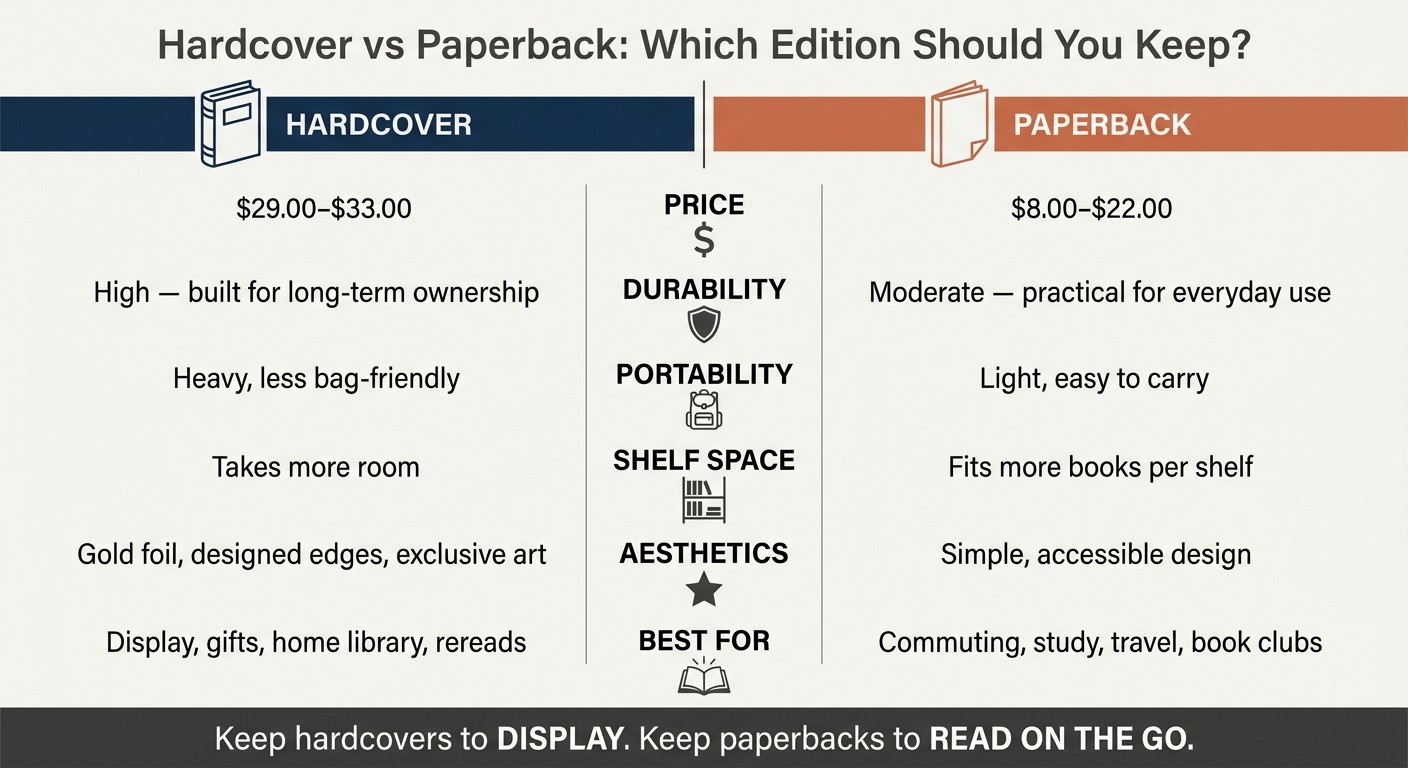
Hardcover vs Paperback: Which Edition Should You Keep?
Factor | Hardcover | Paperback |
|---|---|---|
Price | $29.00–$33.00 | $8.00–$22.00 |
Shelf life | Better for long-term keeping | Fine for regular use |
Portability | Heavier, less bag-friendly | Lighter, easier to carry |
Shelf space | Takes more room | Fits more books per shelf |
Looks | Better for display | More plain |
Best for | Home library, gifts, rereads | Study, commuting, book clubs |
My rule is simple: if the book’s main job is to stay, I keep the hardcover. If its main job is to travel, get marked up, or get read hard, I keep the paperback.
Hardcover vs. paperback at a glance
If you're buying books to keep, the core trade-off is pretty simple: hardcovers lean toward longevity, while paperbacks lean toward convenience.
With that in mind, here’s the fastest way to compare the two formats.
Side-by-side comparison table: durability, comfort, storage, value, and best use
Factor | Hardcover | Paperback |
|---|---|---|
Typical U.S. price | $29.00–$33.00 | $8.00–$22.00 |
Durability | High - built for long-term ownership | Moderate - practical for everyday use |
Aesthetics | High - often features gold foil, designed edges, and exclusive art | More modest - usually the practical, accessible edition |
Portability | Less convenient to carry; best for home use | More portable; easier to carry for commuting, travel, and book clubs |
Resale/collectible value | Higher - especially for Collector's and Deluxe Editions | Usually more utilitarian than collectible |
Typical use | Display/home library | Commuting/travel/book clubs |
One small twist: some newer paperbacks now cost as much as $22.00 and run close to 600 pages, which cuts into their portability edge.
For most readers, the choice comes down to two things: where the book will live and how often you’ll carry it around.
A simple rule of thumb for most readers
Keep hardcovers for display and long-term ownership; keep paperbacks for reading on the go.
How hardcover and paperback compare on the factors that matter most
The choice gets easier once you look at how each format works in day-to-day life.
Durability and lifespan: which format holds up over time
Hardcovers make more sense for books you plan to keep for years, put on display, or reread again and again. Paperbacks work better for books you want to carry around, annotate, or swap out without spending much. A collectible hardcover of a classic novel is the better long-term keeper. A mass-market paperback is often the better reading copy.
If you know you'll come back to a book often and want it to last, hardcover is usually the safer bet.
Durability matters most when a book is meant to stay on your shelf, not just move through your hands.
Reading comfort, shelf space, and everyday use
If you'll be taking the book with you often, size and comfort matter more than how it looks on a shelf. Paperbacks are lighter and easier to carry for reading, commuting, and study. Hardcovers take up more space, which can become a problem in a crowded home library.
That hits home if you're building a home library or already dealing with stuffed bookshelves and TBR piles. Paperbacks let you squeeze in more titles on the same shelf.
Looks, resale value, and cost over time
If the book is meant to stay with you, looks and long-term value start to matter more. Hardcovers usually look better on a shelf, and collector's or deluxe limited editions often come with extra touches. Collector's editions often add premium details like gold foil, designed edges, and exclusive art. That matters most for classics, gifts, and books you plan to reread.
Which edition is worth keeping, by book type and reader goal
Collectors and home library builders: keep the hardcover
Keep the hardcover when display and preservation matter most. Collector's and deluxe limited editions are built for that job, with premium details that can hold up for years on a shelf.
If a book's main role is to look good and last, portability matters a lot less.
Frequent readers and students: keep the right paperback
Not all paperbacks are the same, and that difference matters when you're deciding what stays. Mass-market paperbacks work well as reading copies and are usually easy to replace.
Trade paperbacks are different. For study and book clubs, a trade paperback with notes, guides, or afterwords is often the better copy to keep, especially when it costs about half as much as a collector's hardcover ($31.99).
Some books can do both jobs.
A mixed approach: one reading copy, one keeping copy
Sometimes the best move is keeping two copies: one to use and one to save. The Age of Innocence by Edith Wharton is a good example. A trade paperback works well for study and book clubs, while its place in literary history makes it a strong pick for a permanent place on the shelf.
That leads to one last test: what role does this copy play in your collection?
Conclusion: Keep the edition that fits the book's role in your life
The simplest way to decide is to ask what job the book needs to do.
If the book is for display, gifting, or long-term keeping, keep the hardcover.
If the book is for heavy use, study, or tossing into a bag and taking with you, keep the paperback.
Match the edition to the book’s role in your life, and the choice gets a whole lot easier.
FAQs
How do I choose if I can only buy one edition?
Choose the format based on what you want the book to do for you.
If you want display, shelf appeal, and something that holds up well in a home library over time, hardcover is usually the better pick because it lasts longer.
If you care more about portability, lower cost, or casual reading, paperback is often the more practical option. It also helps to look at any annotated guides or bonus content and choose the format that feels best in your hands, is easy to use, and gives you the most long-term value.
When is a trade paperback better to keep than a hardcover?
A trade paperback often makes more sense when you care about portability, reading comfort, and price. It’s usually lighter and more flexible than a hardcover, which makes it easier to toss in a bag for travel or bring along on a daily commute.
It can also be the better pick for studying or taking notes. Because it’s easier to hold and handle, many readers find it simpler to annotate without dealing with the extra bulk of a hardcover.
Is it worth owning both a hardcover and a paperback?
Yes - owning both can make sense, depending on what you want from a specific title.
A hardcover often works better for durability, display, and collecting. A paperback, on the other hand, is usually easier to carry, easier on the hands during long reading sessions, and more budget-friendly.
A lot of readers do both: they keep a hardcover on the shelf for their home library, then use a paperback for casual rereading, travel, or study.


