

Literature
I treat the literary canon as a claim to question - not a reading list to obey. Before choosing a classic, I check who kept it in print, what its writing achieves, and whether the edition supports close reading.
I use 4 lenses to separate a book’s reputation from its merits:
Writing: How do its language, characters, and structure work?
History: How has it shaped other books?
Institutions: Who teaches, publishes, and preserves it - and who gets left out?
Status: Does its reputation or collectible edition signal prestige rather than quality?
For me, <u>prestige is not proof of quality</u>. I read established books alongside neglected writers, question editorial framing, and choose editions for their text and notes - not just their binding. That includes curated collections such as Timeless Book Club: curation is a choice, not a verdict.
Questioning the Canon
How Institutions Build Literary Status
Gatekeeping decides which texts get a chance to endure. Selecting a work again and again keeps it visible across generations. But institutional support is not the same as artistic achievement. Institutions don’t just preserve books; they shape which books readers see as indispensable.
The Role of Schools, Critics, Publishers, and Archives
Schools and syllabi turn selected texts into shared expectations. Critics guide how readers interpret them, while publishers keep them available. Libraries and archives preserve the texts and their records. Together, these groups grant books institutional authority, reinforced through framing, notes, and presentation.
An editor’s framing can make an edition feel authoritative before readers reach the first page.
4 Ways to Explain Canonical Status
These approaches overlap. A work may show strong craftsmanship, influence later writers, gain institutional backing, and carry social prestige.
Approach | Central question | Strength | Limitation |
|---|---|---|---|
Aesthetic | What achievements in language, form, or psychological depth do readers and critics value? | Focuses on what the text achieves. | Readers and critics disagree about artistic standards. |
Historical | Why do scholars consider the work important to a literary tradition? | Explains its place in literary history. | Influence does not establish universal worth. |
Institutional | Who teaches, publishes, interprets, and preserves it? | Explains lasting recognition. | Selection is not artistic achievement. |
Social | Does the work confer belonging or prestige? | Links recognition to status. | Prestige does not explain every choice. |
Canonical status draws on both what a text achieves and the institutions that support it.
How Canonical Reading Signals Status
Reading canonical works can signal educational or social advantage. Still, judge a classic by what its writing does - through character, language, or conflict - before leaning on its reputation. That status also shapes later debates about whose experiences count as universal.
Taste, Exclusion, and Canon Debates
Once institutions set the canon, the debate turns to whose experience it treats as universal. Twentieth-century canon debates questioned whether elite taste offers a neutral measure of literary worth. Exclusion also results from everyday institutional choices: inherited curricula favor familiar books, while editorial policies often favor established practice over relevance to the present.
Whose Experiences Count as Universal?
A central criticism asks whose lives set the standard for “universal” experience. Reading lists have long centered white, male, European, and socially advantaged perspectives. Women and writers of color have faced barriers to access and recognition. Unequal recognition does not prove literary inferiority, and inclusion alone does not prove literary merit.
This leads to a practical question: how can readers expand a list without weakening close reading?
Adding Authors and Rereading Established Works
Expanding the canon does not mean rejecting familiar works. Critics of inherited standards ask whether “essential reading” reflects the full literary record or mainly the works institutions have preserved. Approaches centered on established works emphasize how those texts shed light on earlier and later writing. Formal achievement, historical influence, and depth of meaning remain useful criteria - not substitutes for institutional approval.
When rereading, look at whose choices drive the story, whose experience remains outside it, and how language or structure gives those limits meaning. Use introductions and historical notes to check your reading against context. Judge neglected authors by the same features, rather than by identity alone.
Prestige Editions and Book Preservation
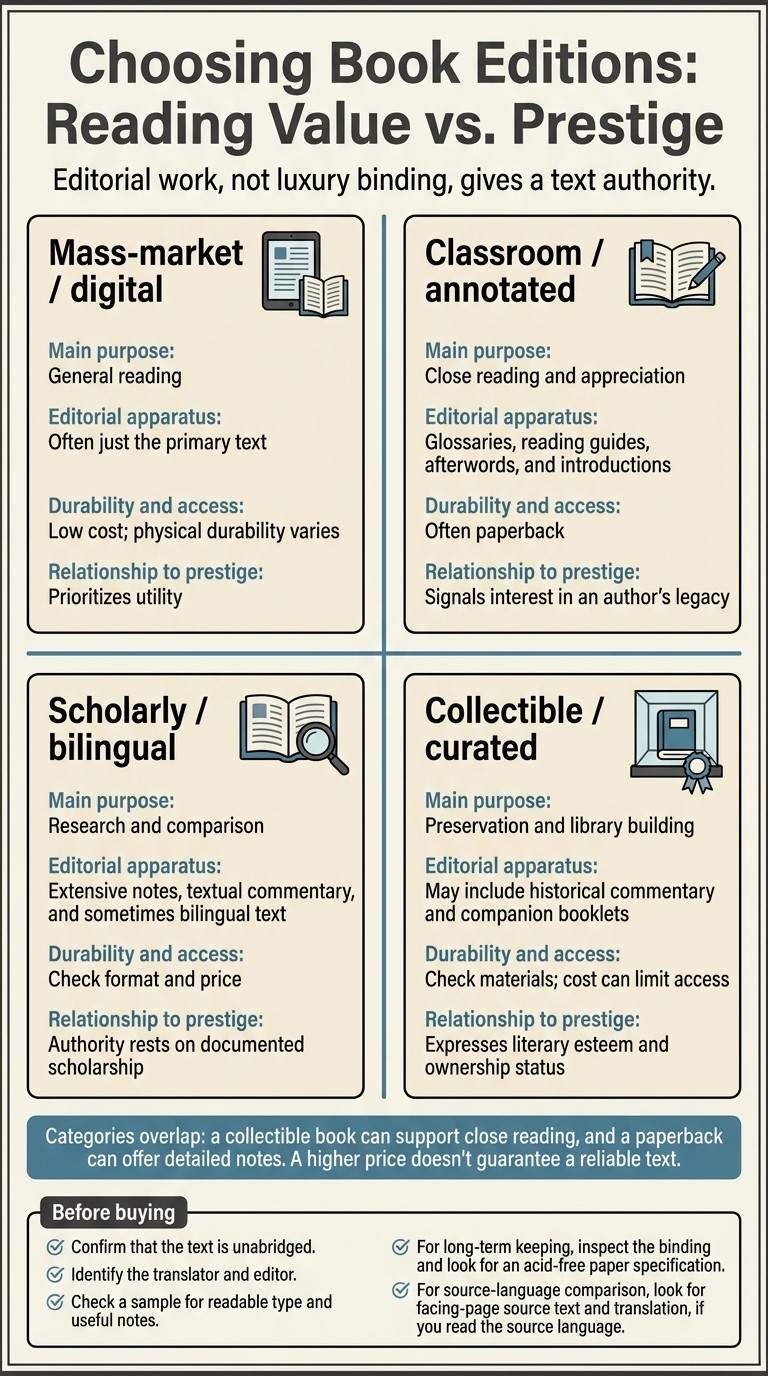
Choosing Book Editions: Reading Value vs. Prestige
The canon’s influence extends beyond teaching and criticism to the edition readers hold. Editions don’t just preserve books in the canon; they also help establish a book’s place there.
Reprints, collected editions, and annotations keep books available and make them easier to study. Durable editions keep authors visible across generations. Collectible editions show esteem, but high prices and scarcity can turn ownership into a status marker.
How Editors Shape a Text’s Authority
Editorial work, not luxury binding, gives a text authority. Check the source text, translator credits, and documentation. Introductions explain a book’s importance, translations shape its language, and notes clarify difficult passages. A higher price doesn’t guarantee a reliable text.
Choosing Editions for Reading and Keeping
Different editions suit different reading goals, so check the editorial material rather than trusting the label alone. Categories overlap: a collectible book can support close reading, and a paperback can offer detailed notes.
Edition type | Main purpose | Editorial apparatus | Durability and access | Relationship to prestige |
|---|---|---|---|---|
Mass-market / digital | General reading | Often just the primary text | Low cost; physical durability varies | Prioritizes utility |
Classroom / annotated | Close reading and appreciation | Glossaries, reading guides, afterwords, and introductions | Often paperback | Signals interest in an author’s legacy |
Scholarly / bilingual | Research and comparison | Extensive notes, textual commentary, and sometimes bilingual text | Check format and price | Authority rests on documented scholarship |
Collectible / curated | Preservation and library building | May include historical commentary and companion booklets | Check materials; cost can limit access | Expresses literary esteem and ownership status |
Before buying, confirm that the text is unabridged, identify the translator and editor, and check a sample for readable type and useful notes. If you plan to keep the book for years, inspect the binding and look for an acid-free paper specification. Facing-page source text and translation make comparison easier if you read the source language.
Timeless Book Club and Curated Editions
Timeless Book Club curates classical literature in collectible editions for readers who value both the text and the book as an object. Treat that curation as an editorial choice, not proof of canonical authority.
Conclusion: Read With Independent Judgment
After seeing how institutions build status, treat the canon as a claim to assess - not a verdict to accept. Canonical status rests on literary judgment, institutional power, historical influence, and social prestige. Reading with independent judgment checks that power without dismissing the canon. A work can matter to literary history without speaking equally to every reader.
A Checklist for Assessing Canonical Works
Separate reputation from evidence. Ask who promoted the work and why it stayed visible. Then turn to the writing: what do its language, structure, and conflicts achieve? Use scholarly histories and reception records to distinguish evidence of influence from repeated praise.
Look at whose experiences the text centers - and whose it leaves out. Does its claim to “universal” relevance overlook assumptions about class, gender, or reputation? Examine how the introduction and commentary guide your reading instead of accepting their framing at face value.
Build a library with room for new evidence. Read established works alongside neglected voices, and note what each book helps you understand. Keep books for their literary value, historical importance, or personal meaning.
FAQs
How can I spot gatekeeping in a reading list?
Gatekeeping often shows up when a reading list favors current trends, commercial popularity, or recent attention over works needed to understand how literature developed. It also occurs when institutions or lists favor abridged or simplified versions that make reading easier at the expense of the original text’s integrity - or leave out the scholarly context readers need to understand a work.
How can I find overlooked classics worth reading?
Choose works that helped shape literary history - not books whose popularity rests on current trends or sales. A useful test: Would leaving this work out leave a gap in your understanding of literary history?
Timeless Book Club selects enduring works for their literary merit and place in the broader literary conversation, helping you better understand how literature has developed.
How can I tell if editorial notes are biased?
Check whether the editorial notes put today’s trends or commercial success ahead of the work’s place in literary history. Strong notes explain why the work matters to the canon, not how popular it is. They should meet the same rigorous standards as the primary text and assess its place in literary history objectively, rather than simply celebrate it.


