

Literature
If your classic reading list feels too familiar, this one gives you 10 stronger left-field picks across 5 countries and 2 centuries. I’d start with the one that matches your mood: social pressure, psychological strain, satire, mystery, historical fiction, or surreal fiction.
Here’s the short version:
10 novels from the 1800s and 1900s
Writers from the U.S., UK, Russia, Japan, and Mexico
A mix of:
Victorian fiction
social novels
psychological fiction
historical fiction
detective fiction
surreal fiction
Best for readers who want classics outside the usual school list
Also useful if you care about modern editions, notes, afterwords, and shelf-worthy hardcovers
What stands out most is the range. You get Anne Brontë on marriage and abuse, Bulgakov on satire and censorship, Nella Larsen on racial passing, Kōbō Abe on entrapment, Ann Petry on Harlem, Bowen and Wharton on social pressure, Collins on early detective fiction, and Carrington on old age, gender, and absurdity.
A few fast facts:
1848 is the earliest publication year here
1974 is the latest
3 books by women would be a low guess - this list actually includes 7
The books span themes like class, race, gender, power, reputation, faith, and control
HAVE YOU HEARD OF THESE 10 CLASSIC BOOKS
Quick comparison
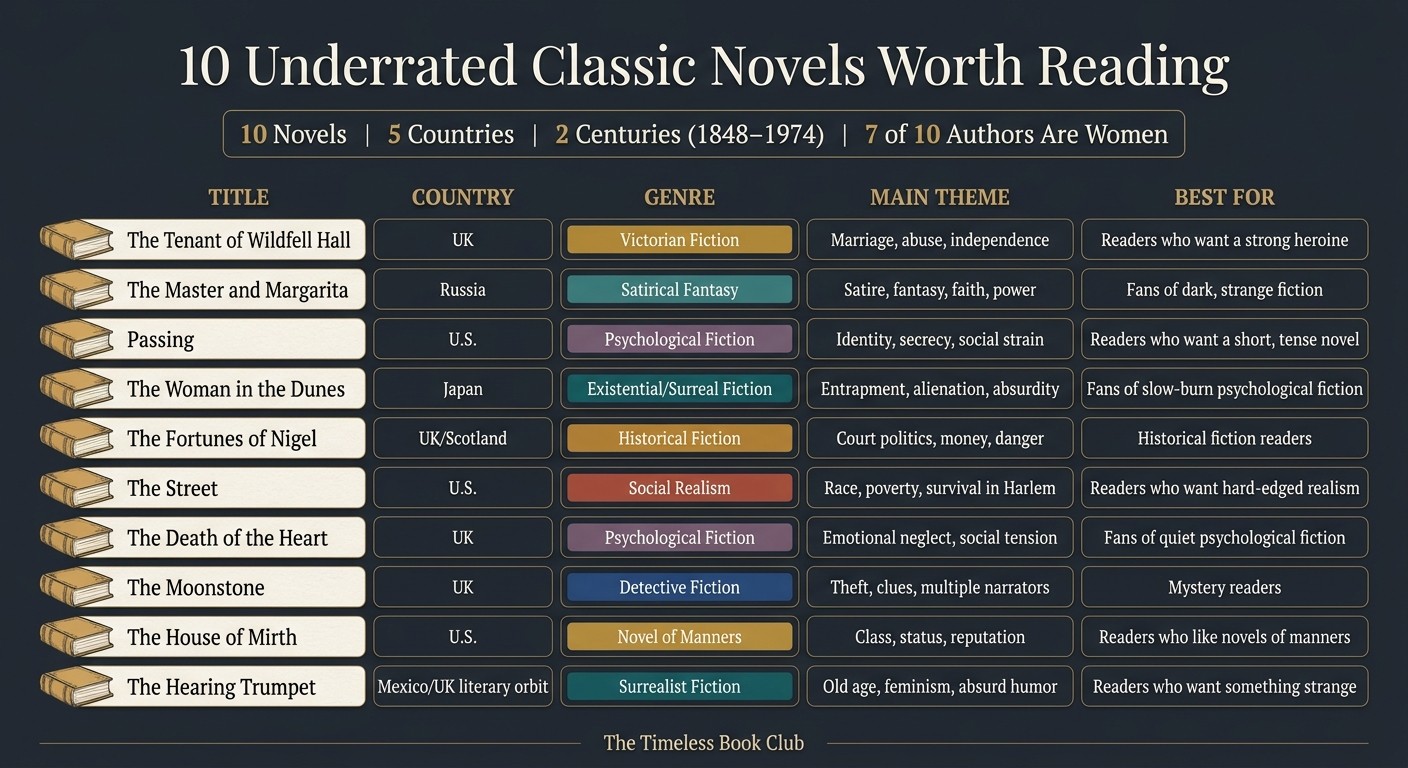
10 Underrated Classic Novels: At-a-Glance Comparison Guide
Title | Country/Region | Main pull | Best for |
|---|---|---|---|
The Tenant of Wildfell Hall | UK | Marriage, abuse, independence | Readers who want a strong heroine |
The Master and Margarita | Russia | Satire, fantasy, faith, power | Readers who like dark, strange fiction |
Passing | U.S. | Identity, secrecy, social strain | Readers who want a short, tense novel |
The Woman in the Dunes | Japan | Entrapment, alienation, absurdity | Readers who like slow-burn psychological fiction |
The Fortunes of Nigel | UK/Scotland | Court politics, money, danger | Historical fiction readers |
The Street | U.S. | Harlem, race, poverty, survival | Readers who want hard-edged realism |
The Death of the Heart | UK | Emotional neglect, social tension | Readers who like quiet psychological fiction |
The Moonstone | UK | Theft, clues, many narrators | Mystery readers |
The House of Mirth | U.S. | Class, status, reputation | Readers who like novels of manners |
The Hearing Trumpet | Mexico/UK literary orbit | Old age, feminism, absurd humor | Readers who want something strange |
If I had to boil the article down to one point, it’s this: the “classic” label is much bigger than the same 10 school-assigned books. These 10 picks give you more range, more surprise, and more ways in - whether you want a book club read, a shelf copy with notes and extras, or just a classic that doesn’t feel worn out.
Why Some Classic Novels Stay Under the Radar
A classic can slip out of sight when one book by the same author becomes the default pick. Once a single title turns into the famous, prize-winning one, the rest of that writer’s work often gets left behind.
School reading lists matter too - a lot. Books assigned in classrooms stay in view for decades. Books that never make those lists tend to drift off, no matter how good they are. Academic backing helps keep a novel in print and in conversation. Without that support, even strong books can have a hard time sticking around. And that gap gets even bigger when a novel is boxed in by genre tags.
Books sold as genre fiction are sometimes passed over by readers who want literary fiction, even when those books are historically accurate and beautifully made.
Time and place matter as well. Novels rooted in a specific era or a faraway setting can feel less universal to some readers. And if there isn’t a modern, reader-friendly edition, even a strong classic can feel harder to get into.
Then there’s the current publishing cycle. Many book clubs lean toward newer titles, which pushes overlooked classics even farther down crowded reading lists. These books are still worth your time. They just don’t get enough attention to stay in plain view. The 10 novels below fit one or more of these patterns.
1. The Tenant of Wildfell Hall
Author: Anne Brontë | Published: 1848 | Genre: Victorian Fiction
Published in 1848, The Tenant of Wildfell Hall follows Helen Graham, a woman hiding her past while trying to protect herself and her son. The novel hits hard because Helen is not just surviving scandal or gossip. She is trying to build a life for herself inside a society designed to trap her.
The book is often cited as an early feminist Victorian novel, and for good reason. It goes straight after coverture, the legal rule that made married women dependent on their husbands. Anne Brontë also refuses to look away from domestic abuse, alcoholism, and a woman's right to leave a toxic marriage. For a novel from 1848, that was bold stuff.
Read it if you want a Victorian novel that blends domestic conflict, social critique, and moral urgency. It has the pull of a tense story, but it also has teeth.
2. The Master and Margarita
Author: Mikhail Bulgakov
The Master and Margarita runs on two tracks at once. In 1930s Moscow, Woland - a strange visitor who is Satan - shows up with a vodka-drinking black cat and a bizarre entourage. At the same time, a second story follows Pontius Pilate in ancient Jerusalem. That split gives the novel its edge: absurdity in Moscow, weight in Jerusalem.
The book’s satire of power, faith, and censorship is what gives it staying power. And its blend of censorship-era politics, fantasy, and theology helped keep it off many standard classroom lists.
Under all the spectacle, this is also a sharp, funny, biting satire. Pick it up next if you want dark comedy, philosophical tension, and a novel that gets better the more you sit with it. It also stands out on a shelf because of its reputation, its range, and its cult following. It fits readers who want literary ambition with a little chaos.
3. Passing
Author: Nella Larsen
Passing takes this list in a quieter direction. Instead of spectacle, it leans on pressure that builds slowly and never quite lets go. The novel follows racial passing and the cost of living inside a false identity.
Larsen uses concealment to study identity, survival, and self-erasure with sharp control. That restraint gives the book its staying power.
Read it for the psychological tension, the social critique, and the way such a short novel can leave a long aftereffect. The moral strain running through it also makes it a strong book club pick.
If you're buying a copy to keep, look for an edition with an afterword or historical essay. Illustrated endpapers, sprayed edges, or a ribbon marker can also give it more shelf appeal.
Next read: The Age of Innocence, another novel shaped by social rules and exclusion.
4. The Woman in the Dunes
Author: Kōbō Abe
Start here if you want the most surreal book on the list. The Woman in the Dunes is a 1962 Japanese novel built on a stark setup you won’t shake off.
Niki Jumpei, a Tokyo schoolteacher who collects insects as a hobby, travels to a remote seaside village. The villagers lure him into staying overnight in a house at the bottom of a sand pit. Then they take away the ladder. He’s left trapped with a widow and made to shovel sand every day so the house doesn’t disappear under it.
That setup isn’t just a clever hook. This is a major work of Japanese existential fiction, and one reason it sits outside many standard reading lists is its experimental, allegorical approach. People often compare it to Kafka and Beckett because it takes one plain, brutal situation and turns it into an allegory about alienation and the loss of control.
It’s a strong fit for readers who like psychological fiction, philosophical tension, or Japanese literature.
If you want a copy for your shelf, look for an edition with an afterword or glossary, plus one or two collector touches like a ribbon marker or a decorated spine.
5. The Fortunes of Nigel
Author: Sir Walter Scott
After the surreal allegory of the previous entry, this pick shifts into brisk historical adventure. The Fortunes of Nigel is a historical novel set in early 17th-century London. Nigel Olifaunt comes down from Scotland to ask King James I for money owed to his family and to save his estate.
Once he arrives in London, Nigel gets pulled into royal court politics. That setup gives the book its drive: a young Scottish nobleman trying to find his footing in the tangled social and legal world of Jacobean England.
The blend of court maneuvering and personal danger keeps the story moving. This is one of Scott’s less-read historical novels, though it deserves more notice for its energy and political detail. Read it for the court intrigue, the social satire, and the fast-moving historical plot. It shows Scott at his best: lively, politically aware historical fiction with a strong sense of place. And if you care about the look of your bookshelves, it also makes a handsome addition in editions with classic cover art or a sturdy cloth binding.
Next read: The House of Mirth for another socially sharp novel shaped by class and pressure.
6. The Street
Author: Ann Petry
After Scott's court intrigue, this entry moves into Harlem's urban realism. Published in 1946, The Street follows Lutie Johnson, a young Black single mother in Harlem, as she tries to build a safer life for herself and her son while facing poverty, racism, and harassment.
Petry writes with a hard edge. There’s no softening the pressure around Lutie, and that’s what gives the novel its force. She turns that pressure into a sharp social novel about how place and power shape survival.
It’s still underread, which is a shame, because its clear-eyed portrait of race, class, and survival in mid-century America still hits hard. Read it if you want hard-edged realism, a strong voice, and a classic that still feels urgent. It’s a good fit for readers who want social fiction with emotional weight and no sentimentality.
7. The Death of the Heart
Author: Elizabeth Bowen
After Petry’s hard-edged realism, Bowen turns the pressure inward. The Death of the Heart follows Portia Quayne, a young woman sent to live with relatives after her mother’s death, as she tries to make sense of emotional neglect and constant social scrutiny.
What makes the novel hit so hard is Bowen’s control. Small gestures, half-spoken remarks, and awkward silences carry real weight. The result is a novel that feels sharp, intimate, and quietly tense.
If you like Austen-style social pressure or Henry James–style interiority, this is a strong next pick. Read it if you want a precise, psychologically sharp novel of manners. Its social unease also sets up the next novel well, especially with its mood of mystery and hidden motives.
8. The Moonstone
Author: Wilkie Collins
After Bowen’s inward strain, Collins turns to a story built on theft, clues, and suspicion. The Moonstone begins with the theft of a priceless diamond, then follows the inquiry through a series of different narrators. That setup gives the book a lot of energy, but its place in literary history is just as striking: it’s widely seen as the first modern English detective novel, and it helped set up genre staples like the professional detective and the locked-room mystery.
Read it for the layered mystery, the shifting viewpoints, and the rich Victorian detail. The many narrators and carefully placed clues still make it one of the sharpest early detective novels. And because the story works like a puzzle, it’s a satisfying first pick for readers who want a classic that still feels brisk and easy to get pulled into.
9. The House of Mirth
Author: Edith Wharton
After the puzzle-box tension of The Moonstone, this pick turns toward social pressure and the quiet force of reputation. The House of Mirth follows Lily Bart through Gilded Age New York, where money and status shape almost every move she makes. At its core, the novel is about the pull between personal desire and public duty.
Wharton writes with sharp control and dry irony, laying bare a wealthy social world that rewards conformity and punishes honesty. She was the first woman to win the Pulitzer Prize for Fiction, and The House of Mirth still stands as one of her sharpest studies of class, reputation, and gender. Like much of Wharton’s work, it’s often pushed aside in favor of classics that show up on syllabi more often.
Read it if you want a novel of manners charged with social tension and psychological precision. It’s a strong fit for readers drawn to class anxiety, suppressed feeling, and the kind of pressure that builds behind polite conversation.
For collectors, this is the sort of American classic that earns a well-made edition. Its visual appeal and lasting place in American literature make it an easy fit for a collectible copy. Next read: The Age of Innocence.
10. The Hearing Trumpet
Author: Leonora Carrington | Published: 1974 | Genre: Surrealist Fiction
Ninety-two-year-old Marian Leatherby gets a hearing trumpet as a gift, and that small object tips her into a strange, funny, and unsettling adventure. Soon, she’s dealing with a sinister retirement home, a mysterious portrait, and a search that twists history and myth into something wildly offbeat.
What makes the novel stand out is its sharp feminist angle. Carrington uses dark comedy and absurd imagery to push back against the way society treats older women, especially when it starts to dismiss them or push them aside. It’s playful on the surface, but there’s a lot going on underneath.
Read it if you like fiction that feels sly, strange, and a little rebellious, with big ideas tucked inside the weirdness.
For your shelf, try to find an edition with illustrated endpapers or a decorated cover that matches the book’s surreal spirit.
From here, the focus shifts to choosing the right edition for your shelf.
How to Pick the Right Edition for Your Shelf
Start with the edition. It sounds small, but it can change the whole reading experience. A good edition makes an overlooked classic easier to get into and nicer to keep around.
Look for publishers that clearly say what’s inside - whether it’s a reader-friendly digital edition, a public-domain edition, or a Signature Collection. Then check for notes or reading aids that can help as you go.
If you want more context, pick an edition with extras like an introduction or glossary. Those small touches can make an older book feel a lot less distant.
If shelf appeal matters too, pay attention to the build. Durable hardcovers and a few well-made extras often add to the book’s display value. Standard editions are usually cheaper, while deluxe collector’s editions cost more. From there, it’s just a matter of matching the book to your reading mood with the quick guide below.
Timeless Book Club offers curated classic editions for readers who want collectible books with lasting shelf appeal.
Quick Guide: Which Novel to Read Next
Use this quick guide to pick your next book based on mood, theme, or genre.
Title | Best For | Why It Stands Out | If You Liked, Try |
|---|---|---|---|
The Tenant of Wildfell Hall | Readers who like strong heroines | A powerful story about independence and social pressure | Jane Eyre by Charlotte Brontë |
The Master and Margarita | Fans of dark satire and the surreal | A wildly inventive fantasy with sharp social satire | The Trial by Franz Kafka |
Passing | Readers drawn to identity and social tension | A study of the psychological and social consequences of racial identity | Quicksand by Nella Larsen |
The Woman in the Dunes | Fans of psychological, slow-burn fiction | A haunting existential parable about freedom and entrapment | The Stranger by Albert Camus |
The Fortunes of Nigel | Historical fiction enthusiasts | A vivid historical novel set in Jacobean London | Ivanhoe by Sir Walter Scott |
The Street | Readers who want raw, socially urgent stories | A sharp portrait of race, gender, and poverty in mid-century America | Native Son by Richard Wright |
The Death of the Heart | Fans of quiet, emotionally precise prose | A deeply felt study of innocence colliding with adult cynicism | Washington Square by Henry James |
The Moonstone | Mystery lovers and genre history buffs | A foundational detective novel in English literature | The Woman in White by Wilkie Collins |
The House of Mirth | Readers who enjoy psychologically sharp, socially rich narratives | An incisive look at class, reputation, and social performance in Gilded Age New York | The Age of Innocence by Edith Wharton |
The Hearing Trumpet | Readers who want something unlike anything else | A surreal, funny, and quietly radical novel that defies easy categorization | Orlando by Virginia Woolf |
If you're in the mood for something intense and character-driven, The Tenant of Wildfell Hall, Passing, and The House of Mirth are strong places to start. If you'd rather go stranger, darker, or more dreamlike, The Master and Margarita, The Woman in the Dunes, and The Hearing Trumpet bring that offbeat energy in very different ways.
Conclusion
Taken together, these 10 novels show just how much classic fiction lives beyond the usual reading list. They expand the canon and shed light on the social rules, class codes, and gender pressures of their time. That depth is also part of what makes these editions worth collecting.
There’s something in it for collectors as well. Editions with glossaries, introductions, and afterwords give readers more context and make for stronger shelf copies.
These novels deserve a larger audience. If you’re drawn to social critique, psychological depth, or historical atmosphere, this list gives you more range than the standard must-read roundup. Pick the title that fits your mood and start there.
Timeless Book Club curates classic works as collectible editions readers return to.
FAQs
Which book should I start with first?
The Age of Innocence by Edith Wharton is a great place to start. It won the Pulitzer Prize and gives readers a clear, inviting look at Gilded Age New York, along with sharp observations about human behavior and social rules.
It’s a strong pick for readers who enjoy polished writing and emotional depth.
Are these classics hard to read?
It depends on the book and on how you like to read. Some classics use elegant but dense prose, odd structures, or dark subject matter, so they can take a bit of patience.
That said, many classics are worth the effort because they deal with timeless themes, carry emotional depth, and still feel relevant years later.
What should I look for in a good edition?
Look for editions that are both easy to read and worth keeping on the shelf: clean, reliable formatting, accurate bibliographic details such as page count, first publication date, and publisher or ISBN, plus useful extras like glossaries, reading-group guides, or afterwords.
For classic fiction collectors, focus on editions that preserve the original text while still making it approachable.


