

Literature
You do not need long, quiet weekends to finish a classic. I can make steady progress with just 20 minutes a day, which usually means 7 to 10 pages per session, 50 to 70 pages a week, and about 210 to 300 pages a month.
Here’s the simple version:
I pick a book that fits short sessions, often 200 to 350 pages
I choose an edition that is easy on the eyes and easy to return to
I read at the same time and place each day
I use a small goal, like pages, scenes, or part of a chapter
I stop at a clear break so it’s easy to start again tomorrow
I write one short note after each session instead of stopping all the time
If a classic feels slow, that usually comes down to older words, long sentences, and extra context. A fixed 20-minute block helps because the job stays small. Read a little, stop, and come back the next day.
A few page-count examples show what this can look like:
209 pages: about 21 to 30 days
336 pages: about 34 to 48 days
521 pages: about 52 to 75 days
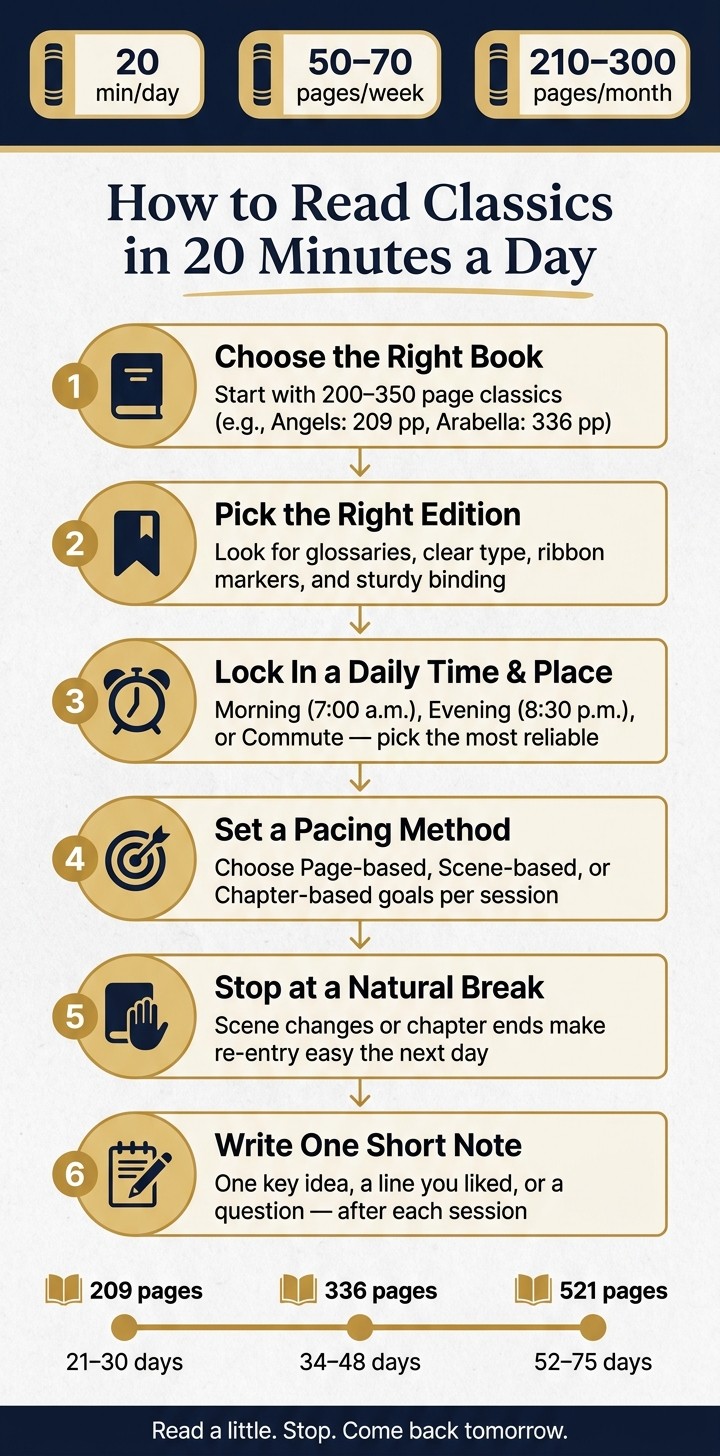
How to Read Classics in 20 Minutes a Day: A Step-by-Step System
Quick Comparison
Part of the plan | What I do | What it helps with |
|---|---|---|
Book choice | Start with a shorter classic | Makes finishing feel closer |
Edition choice | Pick clear type, bookmarks, and notes if needed | Cuts small annoyances |
Reading routine | Read at the same time each day | Makes the habit easier to keep |
Pacing | Use page-, scene-, or chapter-based goals | Keeps sessions clear |
Note-taking | Write one short note after reading | Helps me remember without slowing down |
The core idea is simple: keep the session short, keep the setup easy, and keep moving.
Choose Books and Editions That Work for Short Sessions
The easiest way to build a 20-minute reading habit is to cut friction before you even open the book. That starts with the book itself and the edition you pick. The aim is simple: choose something that fits a 20-minute rhythm, not something that slows you down.
Start with Readable Lengths and Clear Formats
If you're building a daily habit, shorter books are usually a better place to start than long ones. A good range is often 200 to 350 pages. Denis Johnson's Angels at 209 pages and Georgette Heyer's Arabella at 336 pages are good examples of books that suit this kind of routine.
Books with short chapters or clear stopping points also make life easier. When a book gives you natural breaks, it's much simpler to read for 20 minutes, stop, and come back the next day without losing your place.
Look for Editions with Helpful Context, Not Added Friction
A good edition helps you stay in the flow. If you can, look for one with a glossary, reading guide, or afterword so you don't have to keep stopping to look things up. That little break in focus can eat up a big chunk of a short session.
Comfort matters too. Clear type, a sturdy binding, and a bookmark you can count on make a book easier to pick up, hold, and return to later.
Edition Features to Check Before You Begin
Before you buy, check the product description or preview to make sure the edition works well for short sessions. Here’s a simple side-by-side view:
Feature | Standard/Digital Edition | Signature Collection | Deluxe Collector's Edition |
|---|---|---|---|
Annotations | Minimal / reader-friendly | Glossaries and afterwords | Reading Group Guides |
Navigation | Digital bookmarks/search | Standard | Ribbon markers |
Physical Quality | Standard white paper | Paperback with bonus content | Hardcover, ribbon markers, sprayed edges |
Note Space | Standard margins | Moderate | High (often includes custom endpapers) |
A Signature or Deluxe edition can give you more context and a better reading experience, which makes it easier to keep moving through the book. Once you've picked the edition, the next step is turning those 20 minutes into a routine you can repeat.
With the right edition in hand, the next challenge is making 20 minutes a day automatic.
Build a Daily Reading Routine You Can Stick To
Once your edition feels easy to read, the next step is making the routine easy to repeat.
Tie the Session to a Regular Time and Place
The best way to build a reading habit is to link it to something you already do every day. Think 7:00 a.m. with your morning coffee or 8:30 p.m. before bed.
It also helps to use the same reading spot each day. That spot becomes a cue. Sit down there, and your brain starts to read the signal: it’s time to open the book. A set time and place remove friction and make the habit simpler to keep.
Start Smaller if Needed, Then Work Up to 20 Minutes
If 20 minutes feels like a stretch at first, go smaller. Start with a short session, set a timer, and stop when it goes off.
That clear finish line matters more than people think. When you know exactly when the session ends, it feels much easier to start. Then, as the habit settles in, build toward 20 minutes.
Morning, Evening, and Commute Windows Compared
Pick the time slot that’s most dependable, not the one that sounds best on paper:
Window | Best For | Watch Out For |
|---|---|---|
Morning (e.g., 7:00 a.m.) | Quiet focus and an easy way to start the day | You need a steady early slot |
Evening (e.g., 8:30 p.m.) | A natural wind-down before bed | You may be too tired for dense passages |
Commute (train, bus, subway) | Turning idle time into reading time | Digital editions are easiest to use on the go |
Choose the window you can protect on most days. Once that time is locked in, use page targets and stopping points to keep each session moving.
Set Page Targets, Split Chapters, and Stop at the Right Spot
Once your reading window is set, use a simple pacing rule so each session feels predictable. Pick a daily target and decide where you'll stop.
Set Page Goals That Match the Book's Difficulty
Page count is a starting point, not the whole story. Dense prose usually means you can cover fewer pages in the same amount of time. Edith Wharton's The Age of Innocence, for example, runs over 520 pages, and it's the kind of novel that asks for more attention on each page.
That means your target should shift with the book. The aim isn't to cram in more reading. It's to read at a steady pace within the same 20-minute limit each day. If the prose is dense, fewer pages per session is perfectly fine, even when two books look similar in length.
Split Long Chapters at Natural Stopping Points
If a chapter is too long for one 20-minute session, don't force it. Stop at a natural break, like a scene change or a ritual ending such as a ballroom scene or family visit.
Those stopping points make re-entry much easier. You can open the book the next day and know where you are right away. They also make it simpler to jot down a quick note after each session.
3 Pacing Methods Compared
Choose the method that fits the book's structure best:
Method | How It Works | Best For | Watch Out For |
|---|---|---|---|
Page-based | Read a fixed number of pages per session | Books with steady difficulty | Dense sections can throw off your pace |
Scene-based | Stop at scene changes or ritual endings | Character-driven classics | Scene lengths vary |
Chapter-based | Finish one chapter per session | Short-chapter books | Long chapters may run over time |
For dense classics, scene-based pacing often gives you the cleanest stopping points. Once you've picked a method, short notes can help keep dense passages from bogging you down.
Take Light Notes and Keep Moving Through Dense Texts
Once your pace is set, protect it with a simple note system. Dense classics can slow you down in a hurry if you stop for every unfamiliar word or reference. A better move is to keep a running lookup list so you can stay with the text instead of breaking your flow every few minutes.
Write One Short Note After Each Session
After each session, write one short note. That note can be a key idea, a line you liked, or a question to pick up the next day.
3 Note Methods Compared
If you're using a collectible edition, pick a note method that doesn't mark the book.
Note Method | Ease of Use | Portability | Suitability for Collectible Editions |
|---|---|---|---|
Margin Notes | High (immediate) | Low (tied to the physical book) | Low (can permanently mark pages) |
Separate Notebook | Medium (requires an extra item) | Medium | High (keeps the book pristine) |
Digital Notes | High (searchable, fast) | High (syncs across devices) | High (no physical impact on the book) |
A notebook or digital note app works best if you want to keep a collectible edition unmarked.
Use one note, keep your edition clean, and keep your daily rhythm steady.
FAQs
What if I miss a day?
Missing a day doesn’t mean you failed. Consistency matters, but life happens.
If you miss a 20-minute session, just start again the next day. Don’t try to make up for it by reading 40 minutes. That usually backfires.
With classic literature, steady and manageable progress is what builds momentum.
How do I choose my first classic?
Start with themes that pull you in, like forbidden love, social pressure, or a rich sense of history. Edith Wharton’s The Age of Innocence is a good place to begin because it has real psychological depth without feeling hard to get through. It still feels relevant, which makes the reading experience a lot easier to stick with.
It also helps to choose stories that line up with what you care about or want to understand better. And if the book feels a little dense at first, don’t overthink it. A steady 20-minute daily reading habit can help you build momentum and make even heavier books feel less intimidating.
What should I do when I get stuck?
If a book starts to feel heavy, don’t let that break the streak. The main goal is simple: keep the habit alive, even when the material feels dense or hard to follow.
Stick with your reading schedule through Timeless Book Club and keep moving. Some books make you work for it, and that’s part of the fun. Bit by bit, you’ll find new ideas, new questions, and new ways to see things.


