

Literature
A classic is not just an old book. It’s a book people still read, study, and talk about years later.
If I had to boil it down, I’d look for 4 signs:
Long readership: the book stays in print and keeps finding new readers
Lasting themes: it deals with love, power, guilt, loss, identity, or truth in ways that still matter
Strong writing: the language, structure, and characters hold up on a close read
Influence: later writers borrow from it, argue with it, or build on it
A quick fact: many books from the same time period disappear, while a small share remain widely read decades later. That gap is usually not about age alone. It’s about whether the book still gives readers something worth coming back to.
I’d also keep one term straight: classical literature means works from ancient Greece and Rome, while classic literature can come from any era. So Homer is classical, but Austen, Orwell, Wharton, and Achebe can be classics too.
Here’s the short version:
Old does not equal classic
School reading lists and libraries help books stay visible
Themes + craft + influence + time usually work together
A classic keeps meaning something to new generations
If you want a simple test, ask: Is it still read? Does it still speak to people? Is the writing strong? Did it shape later books? If the answer is mostly yes, that’s usually what makes literature classic.
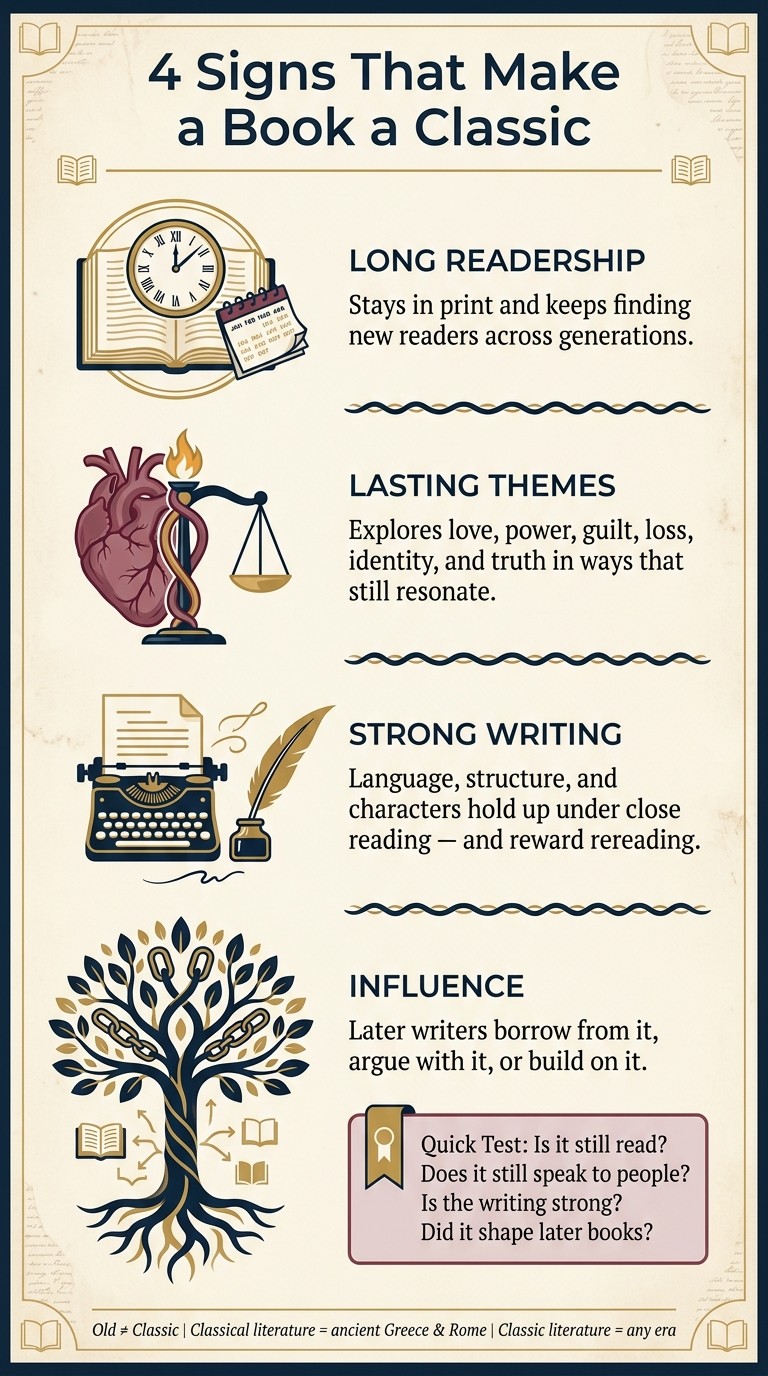
4 Signs That Make a Book a Classic
What makes a book a CLASSIC?
Long readership shows a book has lasted
Age by itself doesn't make a book a classic. A classic is a book people keep picking up because it still speaks to them. That steady return is what sets a classic apart from a book that's simply old.
Why staying in print matters
New editions and reprints are a clear sign that readers still want these books. A book can't keep finding new readers if it disappears from shelves. Reprints point to demand, but a book also needs places and groups that keep it in view.
How schools and public life keep classics visible
Schools, libraries, and book clubs help keep classics in circulation by putting them in front of new readers again and again. That kind of visibility gives a book a longer life. But to keep lasting, classics also need themes and writing that continue to reward readers.
Themes and style help classics last
Visibility helps a book stay on shelves. But themes and writing are what keep it alive. Classic books last because they still speak to new readers, even when the world around them has changed. Their big concerns - love, loss, power, identity - don't belong to one moment in time. People keep running into the same fears, desires, and moral knots, generation after generation.
Themes that stay relevant
George Orwell's 1984 is still a go-to reference for privacy and state surveillance because its main concerns - surveillance, truth, and the corruption of power - are still with us. Fyodor Dostoevsky's Crime and Punishment still lands because guilt and moral ambiguity are human problems, not just historical ones. Chinua Achebe's Things Fall Apart still matters because questions of identity and cultural disruption haven't gone anywhere.
These books endure for a simple reason: their central conflicts still feel human. A reader may live in a different century, use different tools, and speak in a different voice, but the inner struggle feels familiar. That's when a classic stops feeling old and starts feeling close.
Style and literary craft
Theme by itself isn't enough. A book can ask big questions and still disappear if the writing can't carry them. What sets a classic apart from a forgotten novel is craft - the control of the language, the shape of the story, and the way characters are built on the page. Shakespeare's language gives Romeo and Juliet a force that lasts far beyond its plot. Even sentence rhythm and structure can make a book hit harder on a second or third read.
That's why classics so often reward rereading. Pride and Prejudice works the first time as a story about love and social expectation. Read it again, and Jane Austen's irony and precision start to stand out in a different way. You notice more in the turns of phrase, the timing, the small cuts hidden in polite conversation. The writing keeps giving the book more room than a one-time read can show.
And that's often where influence comes in. When later writers keep returning to a book - borrowing from it, arguing with it, or building on it - that lasting pull becomes part of its classic status.
Influence and importance help define a classic
Theme and style matter, but they aren't the whole story. A classic also leaves marks on the books that come after it. A book starts to look like a classic when later writers keep returning to it as a point of reference - borrowing from it, adapting it, or pushing back against it. That kind of response shapes what later writers read, use, and answer in their own work.
How later writers respond to classic works
You can spot influence when a later writer borrows from, reworks, or reacts against an older book. Meg Shaffer's The Lost Story, for example, openly draws from The Chronicles of Narnia.
Sometimes the impact is bigger than any one book. It shows up across an entire genre. Georgette Heyer helped define modern Regency romance, and later writers still work inside the framework she shaped.
Why some old books fade and others last
Some old books stick around because a few things come together at once: durable themes, strong craft, visible influence, and a steady stream of readers. By contrast, books tied too closely to a passing trend often fade when that moment is over.
Edith Wharton's The Age of Innocence shows how acclaim, influence, and continued readership can strengthen each other. When those forces line up, a book keeps finding new readers long after its first success.
Conclusion: A classic lasts because readers keep finding meaning in it
Put together, these traits help explain why some books never quite fade. A classic tends to bring a few lasting strengths at once: themes that still matter from one generation to the next, writing shaped with care and precision, and an impact on later writers or even entire genres. The difference between a book that lasts and one that slips out of view often comes down to how these strengths keep building on each other over time.
If you want a quick way to judge it, look for four signs:
Has it stayed in print for decades?
Do its themes still speak to readers today?
Is the writing strong enough to reward close reading?
Has it influenced other writers or helped shape a genre?
A book that passes those tests has earned its place as a classic. That is what makes literature classic: it keeps earning attention because it keeps meaning something.
FAQs
Can a recent book become a classic?
Yes. A recent book can become a classic, even though the word usually points to a long reading history.
What matters most is the work itself: strong themes that stick with people, standout prose, and ideas that still matter years later. Newer books that speak to identity, social systems, or inner struggle can hit readers hard. If that connection lasts, those books may come to be seen as enduring literature.
Who decides whether a book is a classic?
No one person gets to decide this. A book becomes a classic over time, through years of readers returning to it, talking about it, and passing it along.
It reaches that point when it stays in print, keeps sparking discussion across generations, and still matters because of its emotional depth, strong prose, and lasting connection to shared human experience.
Why do some classics feel hard to read today?
Some classic literature feels hard to read today for a simple reason: it often comes wrapped in dense prose and built around historical settings, social rules, and habits that can seem far from modern life.
The challenge doesn't stop there. Readers may also run into pacing that feels slow by today's standards, story structures that work differently than modern fiction, older language, and moral frameworks that don't line up with what many people expect now.
That extra effort can be demanding. But it also gives these books part of their appeal. They offer a rewarding window into the past.


