
Literature
If you want to start reading classics, I’d keep it simple: pick one book based on length, reading ease, theme, and genre - then stop comparing and start reading.
Most first-time readers do not need the “best” classic. They need one they can finish. In this guide, I’d narrow the choice to 5 books: Animal Farm, The Great Gatsby, Pride and Prejudice, Dracula, and Jane Eyre. Of those, 2 are short entry points, 2 are more character-focused, and 1 leans on suspense and mood.
Here’s the article in plain terms:
Start short if you want momentum
Pick clear prose if older writing slows you down
Match the book to what you already like
Read one book at a time
Choose an edition with notes or a glossary if needed
About 40% of the books named here are under 200 pages, which makes them easier first picks. The list also covers a few common reading lanes: satire, romance, gothic fiction, and social drama.
Quick Comparison
Book | Approx. length | Reading ease | Best if I like |
|---|---|---|---|
Animal Farm | ~100 pages | Easy | Satire, allegory |
The Great Gatsby | ~180 pages | Easy to medium | Short novels, social drama |
Pride and Prejudice | ~300–400 pages | Medium | Romance, manners, relationships |
Dracula | ~400 pages | Medium | Suspense, gothic fiction |
Jane Eyre | ~500 pages | Medium to hard | Character-led stories, romance |
Bottom line: I’d start with the book that feels easiest to open and most likely to keep your attention. For many readers, that means Animal Farm or The Great Gatsby first.
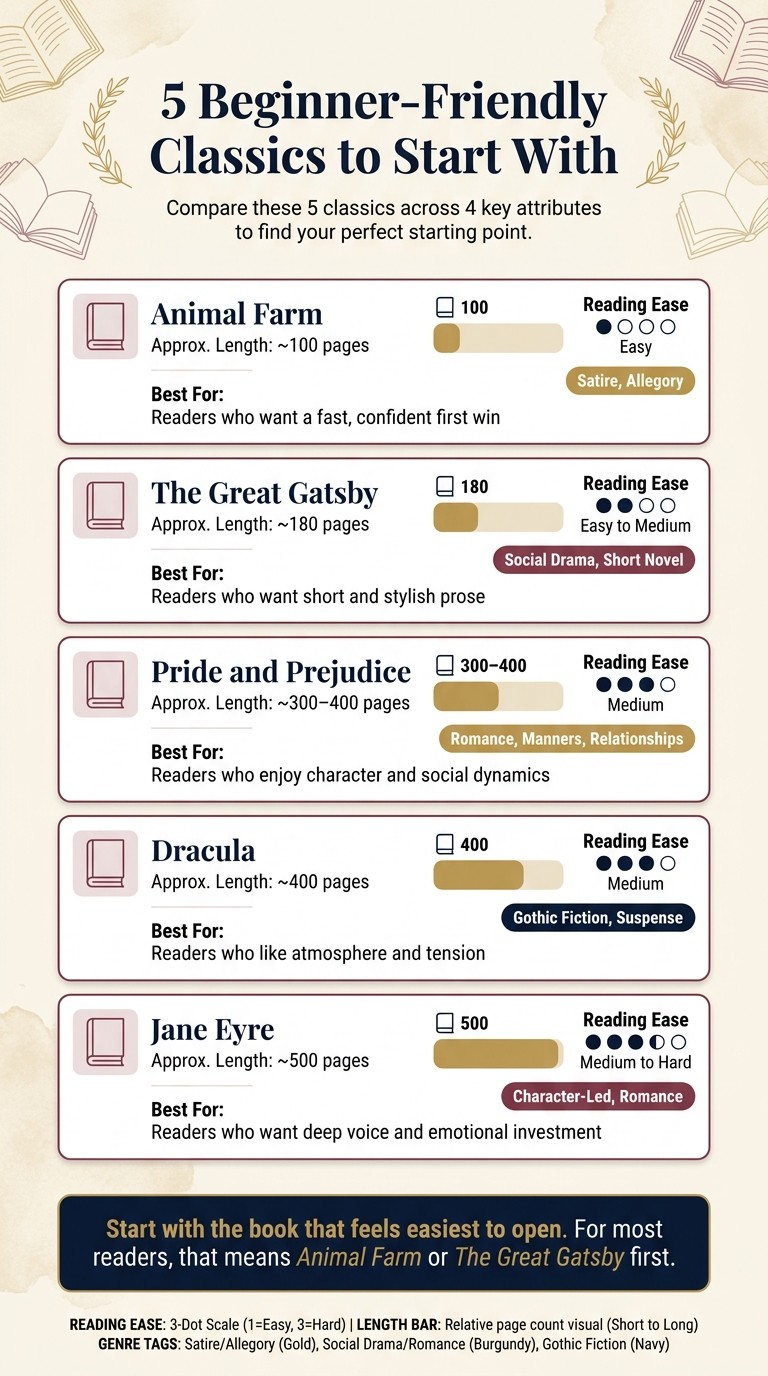
5 Beginner-Friendly Classics Compared: Length, Readability & Genre
Step 1: Use four simple filters to narrow your options
Start with length. Then check readability. After that, pick a theme or genre you already enjoy.
Start with length
The fastest way to build confidence is to finish a book. That first finish does more for momentum than most people expect.
A shorter book gives you less space between page one and the last page. That early win counts.
Title | Approx. Page Count | Difficulty Level |
|---|---|---|
Animal Farm | ~100 | Easy |
The Great Gatsby | ~180 | Easy/Moderate |
Pride and Prejudice | ~300–400 | Moderate |
Dracula | ~400 | Moderate |
Jane Eyre | ~500 | Moderate/Hard |
If length is the main thing you care about, start with Animal Farm or The Great Gatsby.
Then look at readability
Length tells you how long a book may take. Readability tells you how hard it may feel.
A classic with direct prose, clear plot movement, and natural dialogue is usually much easier to get into than one with dense, old-fashioned, or highly experimental writing. Same page count, very different reading experience.
Feature | Easier Entry Points | Slightly Harder Entry Points |
|---|---|---|
Prose Style | Direct and transparent | Graceful, exact, and often ironic |
Plot Movement | Fast-moving and linear | Driven by social rituals and internal conflict |
Dialogue | Natural and easy to follow | Governed by unspoken social codes |
Focus | Clear moral allegory | Nuanced study of society and the heart |
If older language tends to slow you down, pick an edition with a glossary or reading guide. Once you’ve used length and readability to narrow the field, match the book to a theme or genre you already like.
Then match the book to a theme or genre you already like
This is the most personal filter, and often the most helpful.
These books give you a few clear lanes: romance, satire, gothic suspense, and moral allegory. You do not need to leave your comfort zone on day one.
If you like romance and social dynamics, Pride and Prejudice or Jane Eyre make sense as starting points. If you prefer dark atmosphere and suspense, Dracula fits. If you want satire, Animal Farm is a strong place to begin. And if you want something short and readable, The Great Gatsby is a smart pick.
Step 2: Choose from a short list of beginner-friendly classics
Now that you have four filters, here are five classics that line up well with them. The idea is simple: pick the one that matches the kind of reading experience you want.
Short, fast-moving picks: Animal Farm and The Great Gatsby
Animal Farm and The Great Gatsby are your best bets if you want a short, clear first classic that doesn’t feel like work.
Character-driven picks: Pride and Prejudice and Jane Eyre
If you like books that pay off through character, tension, and relationships, start here. These are strong picks if you want emotional depth and people you can stay invested in.
Pride and Prejudice is a sharp, readable novel about manners, class, and relationships. Jane Eyre is a good choice if you want a distinct voice and one central character to follow closely.
Plot-driven and atmospheric picks: Dracula
If you’d rather lean into mood and suspense than social back-and-forth, go with this one. Dracula works well if you like suspense and a clear genre lane. It has a strong gothic atmosphere and a clear suspense hook.
Step 3: Make a simple first-book plan you can actually follow
Once you have a short list, your next move is to make the decision easy. Use the same filters to choose one title, then stop comparing.
Pick one book and read it before adding more to your list
A common mistake new classic readers make is trying a few classics at the same time. That usually leads to decision fatigue instead of progress. The one-book-at-a-time rule helps you avoid that trap and build confidence by finishing what you start.
Start with one book, not three. Read one book at a time, and don't add another until you finish it.
Choose a book you also want to own
The physical book matters more than people think. Try to find an edition with glossaries, reading notes, and historical afterwords. Those extras can make older language easier to follow and give you some backup when the text feels unfamiliar.
A book you want to keep is easier to start, easier to come back to, and easier to finish.
Conclusion: Start small, choose clearly, and keep reading
You don’t need formal literature training to start reading classics. You just need a simple way to pick one.
Start with length. Then look at readability. After that, narrow by theme or genre. At that point, the hard part is mostly done. Pick one title and begin.
Go with the book that feels easiest to open and most likely to hold your attention.
Read one book to the end. Then decide what comes next.
Start with one book. Finish it. Then move on.
FAQs
Which classic should I start with if I rarely finish books?
If finishing books feels hard, start smaller. Pick a shorter classic or one with a clear, fast-moving plot.
George Orwell’s Animal Farm is a smart place to begin because it’s short and packed with meaning. You could also try Pride and Prejudice if you like sharp character drama, or Dracula if you want a story with more suspense.
What if I struggle with older language?
You’re not alone. Older language can feel a bit intimidating at first, but it usually gets easier once you have a few simple tricks to lean on.
Start with editions that include glossaries or reading guides. They can help with unfamiliar terms and give you the historical context you need without slowing you down too much. It also helps to pick stories with strong, engaging themes. When the story pulls you in, it’s much easier to look past the older wording and settle into the author’s voice.
Should I read more than one classic at a time?
That depends on your reading habits and comfort level. Some people do best with one classic at a time. It gives them space to settle into the language and stay close to the story.
Others like to rotate between books. That can help keep things from feeling heavy and make it easier to stick with the habit.
There’s no right or wrong way to do it. Go with the approach that makes classics feel manageable and enjoyable.


